Within & Without

 She is the link between one thought and the other; she is the conduit through which my senses connect to the life outside. She remains still in the moment yet flows from one day into another, filling my time and space. She was an amazing woman who nurtured me, loved me, pushed me, admonished me , made fun of me and she was there in all my difficult times and is still there when I am at the crossroads.

That is my grandmother. I remember the moment, when I clearly communicated my preference to stay with her rather than go with my parents to another place. What could have prompted that four year old to move away from the love of parents to live with the grandparents?

I could have been attracted by the big house filled with people with some interesting activity going on almost always, the legendary cooking skills of my Patti (grand -mom) or her sensory rich story telling;  but there was a pull/connection that was beyond the power of words between her and myself. 

Abiding by the traditions of the period (the 1930s) she was married off just as she was entering her teens. She had not seen her husband before the marriage. Her in-laws family was a big joint family with a typical patriarchal structure. 

When she had to be formally invited and brought into her newly acquired home, there were demands for diamond earpieces and nose stud. The usual negotiations, the voiceless husband who placed obedience to elders and the patriarch as the highest attribute and the uncertain waiting period had all created a deep impact on the 16 year old young woman. She was blessed to be surrounded by brave and wise women and particularly her aunt (wife of father's elder brother - (काकी/ பெரியம்மா) who taught her to recognise her self worth and how to hit a home run when life threw her a curveball. She had an analytical mind and was gifted with a photographic memory. She was so methodical, great at planning the little details and rational in her approach to people and events. Her photographic memory and the sharp brain enhanced her story-telling sessions. 

(How I loved the dark nights with the sounds of the city slowly winding down, the only voice used to be Patti's. Lying next to her on both sides, my brother and myself used to demand that she faced us while narrating the war between Rama and Ravana or the childhood exploits of Krishna. She used to deal with the sibling rivalry, with an innate sense of humour.)

I have lost count of the number of times she has narrated the story of her aunt, giving a great declaration to the patriarchs of the family, and the elder and junior mother-in-laws -" She is no more our daughter but your daughter-in-law. We have given all that we can as wealth to support her. This very same young woman that you now look down upon, will be your nurturer and you all will be looking up to her in the coming years." I remember patti telling me how this great grand mother advised her to stand firm yet show love and respect to all of them as they were to be her people. 


She never lost her cool when her husband completely ignored her for days together. Her self confidence and conviction in what is right turned him around and all the elders - not only her in-laws but even thatha's (grand father ) uncle and aunt, who were looked after by her in their old age. With the passage of time, the patriarch of the household, the uncle used to come and ask her opinion on many issues, I have heard . 


She was tall for her generation of women and was always neatly turned out in her nine yards saree. Even after cooking a feast for about 50 people, she would remain fresh with no hair out of place. Her management, financial skills and planning were amazing! She never compromised on the daily rules and disciplinary routine till the end but that did not cause trouble to others. There was no blind faith and rituals in her life and she had beautifully sketched the nuances and layers of each of the festivals we used to celebrate at home. 

Her classy and subdued style of dressing up had its appeal to the third generation too. My elder daughter, during her marriage, insisted on patti's supervision of her hair do and dressing up.    

There was never a moment in her life when she could heave a sigh and feel relieved of her difficulties. Her only son (my mama) had a developmental disorder (with hindsight, we make a guess it could be autism spectrum disorder) and her daughter (my mother) was physically not a very healthy person and had occasional depressions as well. She had to confront the people at home to consider medical help for her son. Without awareness about these conditions, people lacked sensitivity and empathy to deal with such disorders. she managed to find her own procedures to engage her son and let him grow in his own pace. She very well knew that worrying about what would happen to him after she was dead and gone was futile. None of these challenges hampered her zest for life. Her quest for knowledge, sharp wit, narrative skills and that sense of humour earned respect and affection from the people around her. 

Every where I turn around, every work that I do; the way I deal with people - in every small and big event, I feel her presence and I hear her voice. Many times during a day, I bring her alive as I talk about her to whoever is there with me. Many times, I am alone, listening to her as she would have been saying something and doing something. The past and the present blur; she is within, yet out there engulfing me with one assuring glance...

My first hero to model on was her and I realise she still remains someone I can draw inspiration from.

The web of connections


That is Govindu, the travelling singer! Perhaps he is descended from those wandering bards of bygone days! Or maybe he is from the family of minstrels coming to the city in search of a better livelihood! He is from Andhra, staying in 'Urapakkam' a southern suburb, away from the hustle-bustle of metropolitan Chennai. Does he belong to the Chenchu tribe; or is he from Jangama tribe or Dasari tribe?

With the harmonium hanging from his shoulder, he moves along these residential streets of this part of the city once in a month, perhaps. (It may be more than a month also many times.)

A voice that needs no mic, resonating with devotion(Bhakthi) and gently sails with the wind to reach my ears in the morning.

He came this morning , after about a month and half; a lazy and quiet morning just before the usual vendors would fill the air with their sing song calls. Here I was contemplating on the design of the 'kolam' the kolam powder leaving my fingers in flashes of white lines and curves; the rich timbre of that voice calling 'Vittala' from the other end of the street, moving the length of the street to gently nudge me!

I paused my kolam; hurried down the steps to see him in front of our apartment. With just a slight flicker of his eye balls and a subtle lift to face me, he was able to communicate the message that he knew me. Who? The person as the one connected to his last trip here or the person from that particular balcony or another soul who loved the sounds, the music? Later he told me that he remembered my daughter talking with him.

He played the harmonium for a few minutes and turned towards the opposite house. That is when I asked a meaningless question, " Why don't you sing?" Once again with the turn of his head and a quick glance, he conveyed something! Was he trying to point out the meaninglessness of my question? He was singing and moving from the other corner of the street and the street was reverberating with his music for the last 15 minutes. He would continue with his songs anyway. So why did I need to ask him? He has been handed down this music from some distant past and the only way he knows is to share it with other beings and communicate with them through that music. You see the way he shows up for this activity. With the dhoti tied in a particular way, his forehead adorned with Vibhuti (the sacred ash) head held high and with complete dedication he sings.

The music, unrestrained by any grammar, the Bhakthi flowing out in bhajans and Abhang is not his alone. He carries within his voice and music, generations of such music; the sounds fill the air and the ears receive them. All the beings, are in sync with the flow.

I got back to my routines? Did I really? I was immersed in the experience of the music, the tradition of wandering minstrels and Govindu's voice for more than half of the day. I was once again in the Global summit session with my mentor, Bhavana. Brimming with passion, her voice was asking me to observe the continuously repeating patterns ; to stay in the territory, explore and ponder.

I am contemplating on 'SANKOFA' (Go way back and get) .

From where have we modelled the notes(swaras ) that combine to create beautiful sound? All the sounds in nature - the gentle rustle of leaves, the slow waking up of different birds with their calls, the still hot day, the hungry calls of the fledglings and many more - create a symphony. The silence in the open space, the underlying shruti binding all sounds - isn't that the beginning of all music!


The emotions of traditions

Celebrating Savitri pooja/’Karadaiyar Nonbu’ my way.

This ‘vrath’ or nonbu is observed on the day of transition of Sun from Aquarius into Pisces. That usually occurs when the Tamizh month of Masi (Magh – January/February) ends and the next month- Panguni (Phalguna) begins.


Married women observe this ‘Vrath by fasting on the last day of month of Masi for the well-being and long life of their husbands. Sometimes, unmarried women also observe this vrath to get an ideal life partner. Just before the birth of the next month (Panguni), they worship mother goddess and offer the traditional sweet called ‘Karadai’ blending rice floor and jaggery and steaming the round shaped ‘adais. We add handful of cooked (lobhia/chavli – Karamani) black eyed beans and grated coconut also to this. Then with a seasoning of mustard, green chili, ginger and curry leaves make a salty dish as well. One should not forget to keep a cup of butter along with the other offerings.

(How anyone would have thought of these subtle combinations??” I wonder!)   “Don’t men find the need to pray for the well-being and long life of their wives?”

I love the story of Savitri, the determined woman, who challenged Yama, the god of death to bring back her husband alive. Her resourcefulness and keen observation of the lord of death and his language makes Yama yield to her request and arguments. She pleases the lord with her determination and gets three boons – she enables her father-in-law to regain his eyesight and also his kingdom; her parents are blessed with a male child and Yama agrees to her request of begetting 100 children!! She then points out that, being a loving wife, she cannot have her children without her husband alive. Yama, pleased with her presence of mind bestows the three boons.

Ever since I have first heard this story, it is her self-confidence and resourcefulness that have made a deep impact on me. Her father appreciates her intelligence and respects her choice of husband. (even though he comes to know of his limited time on this earth.)

I loved to be around the place when Patti (grand mom) prepared the special delicacies and observed these traditions as there was one aesthetic flow to her movements that blended with all things around her and a rhythm to her processes that soothed me. Then there were those delicacies! Hm…. I can smell the aroma, feel the texture and the taste bursting on my tongue even now!

This set the trend and pattern in my life to follow all the traditions and cook all the delicacies that she created as she continues to be present in all these actions, thoughts, the aroma of cardamom, jaggery boiling or the offerings and prayers. I feel enveloped in her loving hug!

So, I don’t care for the social taboos and stigmas like ‘meant-for-married-women only’; ‘not- for-widows’. I go ahead and observe all those traditions and make the special dishes and offer to God. This time, I paused on the day of ‘Savitri pooja’ – reflected about all these and the great woman.  I started a new invocation and offered a new prayer – calling on Savitri to pass down her resourcefulness, determination and courage to us, all women in need of that. I reached out to all other wise women and nurturing women to guide us through this life. That, of course included a very special prayer to my Patti.   


 Web of life

Life on earth is one giant web, consisting of multiple smaller webs within. I came across a veritable treasure of a book, while searching the web for ideas related to the environment. This book is an eBook in pdf form - "Empowering Stewards of Nature-Lessons from our web of life" by Bill Graham, a marine biologist, researcher and educator. He calls himself 'a student of nature'. His passion for the 'interdependence and connectivity', and all energy connections within Nature has deeply resonated with me.   

The feeling of this connection to all creatures of this planet has been growing stronger and deeper within me, more than ever before. (This connection is magnified tenfold occasionally, when the outline of the physical body blurs in my mind.

I can very well visualise Bharathi's total bliss as he embraces every creation as his own! (Subramaniya Bharathiyar was a poet, freedom fighter and social reformer from Tamil Nadu. He was known by the epithet -'Maha kavi' meaning great poet)

"காக்கை குருவி எங்கள் ஜாதி – நீள்  கடலும் மலையும் எங்கள் கூட்டம்" ;

(The crows and sparrows are our kith and kin; Seas and mountains - our hearth and home; We are abound everywhere around)

My connection reaches out to all beings in my environment. The ever present crow community, the pigeon gang, the chirping mynah on the kitchen window sill and my little squirrel friends keep me company through the day. 

The tinkling leaves of the peepal outside my balcony add to the lazy somnolence of post lunch bliss. The huge cows lazily roaming the street, nod their head with a sudden snort and observe me sagely when I step out onto my balcony. And of course the ever vigilant street dogs guarding their territory, keep up a constant tune with their barks in the background. My special bond  with all the plants that we have in our balcony, completes the circle of connectivity. 

The street vendors with their individual trade calls, that  indicates the time of the day carry a myriad of stories, and that is for another day.

How can I not include the connections through social media,  which brings many interesting and sensitive human beings into contact with each other and me. (I go slow with technology, taking tentative steps. However, there are some deep connections in this too!)

I happened to connect with a curious, warm, enterprising woman by the name, Sashirekha Lakshmanan. She loves cooking and creating pretty designs of kolam and writing is one of her passions. She writes short stories and poems in Hindi and Telugu.  One other great passion that she has is to grow and nurture plants. She shares a lot about her plants and posts pictures of them.             


One particular post of the colourful violet  blooms and pink flowers, side by side in  their earthen pots, caught my attention and imagination. The image stayed with me for a long time, that particular day and I expressed it in  the shape of a kolam the next day.  
One particular post of the colourful violet 
blooms and pink flowers, side by side in their earthen pots, caught my attention and imagination. The image stayed with me for a long time, that particular day and I expressed it in  the shape of a kolam the next day.


The colours, orange and pink, have called out to me and so I have let these colours flow from my fingers to become five little flowers! 

I experience the passion and sense the conviction completely when I remember the words of Bill Graham (the author of the eBook): " Nothing exists solely on its own. From the most minuscule atomic particles to the grandest galaxies, the past, the present and the future of every animate and inanimate being in our universe, including human beings, is defined by its interconnection to every thing else." 

When we open up to the sounds, colours and the minute movements of the things around us, we are part of the system and we move with the backing of all other beings and objects in the system.

As Bill Graham quotes Henri JM Nouwen ( Dutch catholic priest, professor and writer), "We can offer a space where people are encouraged to lay aside their occupations and preoccupations and to listen with attention and care to the voices speaking in their own centre." 


The Month of Love - February


I associate happy feelings and a sense of expectation, with the month of February(completing one academic year and awaiting the new year). There is new life emerging all around, and the birds and animals I watch appear to be more alive than before. 

These days, I am more curious to find out why it is so. One thought stands out, and that is  my association with the general rhythm of the environment around me. When I pause now to observe all these emotions, I understand that it is the onset of spring, with the warm sun nudging all life with his rays and letting his energy flow into every thing on earth.  Still, there remains a crisp bite to the air and we all enjoy cool evenings and nights. 
Since my school days, when I was a clumsy, skinny girl of 11, I have fond memories of this month; the tentative friendships that started at the beginning of the academic year, would have developed into a comfortable camaraderie.
I still remember the hurried frenzy of completing learning portions, the surprise tests, preparing for the examination and the occasional combined studies very vividly. I have also sensed a different excitement thinking about the holidays, to be spent with my parents (particularly with my Appa). 
In the traditional set up that I grew up in, this month was one of the two occasions (annually) when I used to get a new set of clothes for my birthday!  (I had no idea of my date of birth as it was my birth star that people at home paid attention to. This was calculated on the basis of the tamizh calendar.)
During my college days, this month became one of the most cherished times with projects, competitions, sports day and annual day functions and farewell parties. 


Yet another particular day in this month stands out in my mind. Consider it one of those eccentricities of mine! (I certainly have a list!) Here it is! Psst! my favourite number is seven. Every teenager has  one idea/hobby/personality, that resonates and manifests in all our behaviour obsessively for days together and one fine morning, it disappears and shifts to something else entirely. For sometime, I was crazy about numerology. I happened to come across a book on that subject at home and the fever caught me! Through a series of calculations, I found out number seven is my numerological profile number.

When I think of the six plus decades  of my life here, I recognise the connection with this number. The best and the closest -to- my- heart connection is with 7th February. 
 
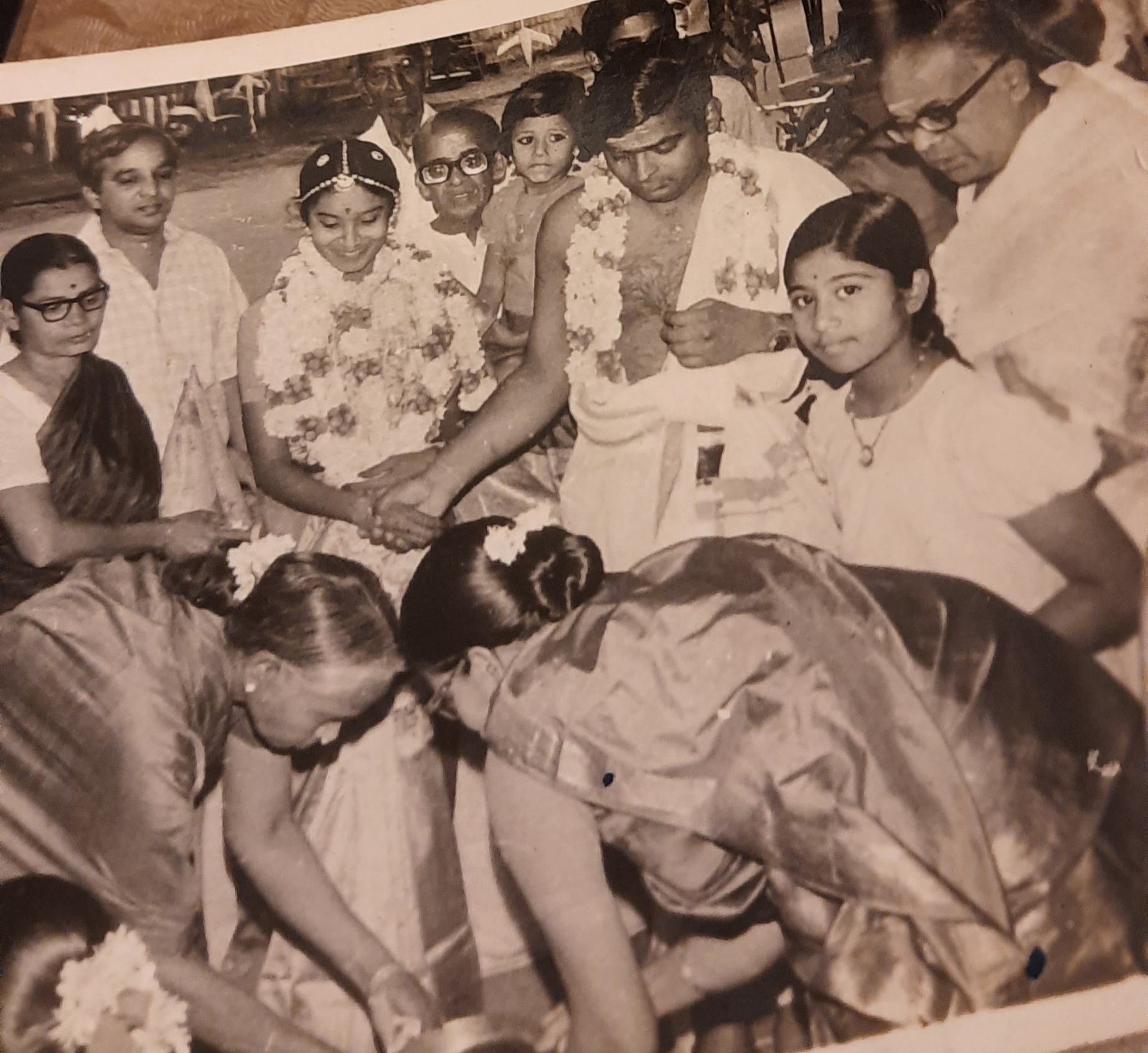
That was the day, I got married to a  wonderful human being, who had led me to discover my inner strengths and talents. It was with a lot of doubt, fear of the stranger and so many other unexplainable questions, that I faced that day. (Enjoying the attention and having a lot of my loved ones around me notwithstanding!)
The very same evening, he showed me his care for fellow human beings, by the way he listened to me completely - yes, not only to my words but to me wholly. It was an exhilarating experience, and I sensed in that moment that in the gamble of arranged marriages, I had hit a jackpot!. Two days later, when I was travelling towards Central station (Chennai) to board Howrah mail along with my father and my husband, the tentative shoot of love took a firm hold and bloomed with leaves and flowers to grow into a lovely plant. He turned around, and took hold of my father's hands in his huge hands, looked into my father's eyes and told him, " Don't worry, Appa. I'll take care of her." so gently and with empathy. The moment is etched so deep in my heart that I can shout my love for him unabashedly.
I earned an adoring little sister that day. My sister-in-law was hardly 12 years old and followed me closely, like a loving puppy. It was a moving experience for me, as I had not so far seen demonstrative people. (The brother and sister duo, I realised later, were and are gregarious human beings. ) This sister, has grown to be beyond a sister in law to me, with her intuition and thoughtfulness.                


I have known the phrase," Living life to the hilt" but to experience it was a dream come true! Every moment of my life spent with my husband was that - nothing held back and to live in the moment fully!. I can say it was a very short time of six years and a little more, that melted like ice under the sun. 


But it was celebration of life's each moment, like the slow motion frames on a screen. As I live my life now, I get a whiff of the winter smell, the hot phulkas (whole wheat flat breads which are soft and fluffy) cooking, the sounds of the evening prayer and bhajans from the jawans' living quarters, the ricocheting sounds from the training ground, and the bellowing voice of my husband. I remember the  sense of coming home, in the security of his broad strong shoulders and I recall the romantic moments that his eyes could create - on and off! I relish them all and send a prayer of gratitude to the universe for the connection and joyful life! So, it is about 197 million , two hundred thirty one thousand  and seven hundred and twelve most precious seconds of my life (197,231,712) the eternal fountain of life and joy.


Winter flavour


It is winter somewhere in a small town in northern Punjab! Ah.. what would I not give, to enjoy the foggy mornings, the warm sun, the sharp bite of cold wind, an unlimited supply of ginger tea and a walk in the golden mustard fields! Thanks to Yashraj films and Bollywood romance, I think many of us can visualise the passionate? meeting of the hero and heroine amidst the gently swaying mustard plants with golden flowers 
( Kajol and Sharukh, may be!). 


I keep imagining the bite in the air, the cold wind on the face and the typical winter colours, vegetables and fruits. Sometimes, the present merges with the past and one smoothly flows into the other.   I can experience the cold seeping through every pore of my being, and inhale the aroma of hot, spicy and colourful mixed vegetables - carrots, peas, potato and cauliflower. 

Winter in Punjab is incomplete without 'Sarsoon da saag and Makki di Roti'! Associations of smells and images stay etched deep in our memory. I think of that foggy winter evening more than 35 years ago; our one year old daughter all bundled up, when we travelled all the way from Chennai to meet, and stay the night with a close friend of my husband in Delhi Cantonment. I got to experience the Jat hospitality that evening, with Makki di roti and sarsoon da saag. Whenever I think of winter and sarsoon ka saag, it brings to mind the excitement of a new beginning and the love and attention I enjoyed then. 

So here I am, some forty years later, feeling the same excitement and enthusiasm for meeting and connecting with all things around me! Thanks to my ecosystem (our domestic help with the fond memory of the farming during her younger days,  is a major player) which nurtures me with greens, flowers, butterflies, bees and birds, the little patch of soil I have in my city apartment, has yielded mustard leaves and a kind of local palak. 


The growing bond:
From the day, I recognised the mustard plant, every morning, she would draw my attention to herself and at some deeper emotional level a silent conversation(?!!) started. Like a chant, I would hear 'sarsoon da saag'. 
a conversation would then begin:

Me: Saag? I don't know how to cook that. Do I need to pluck your leaves and make that?
Sarsoon: What else? My golden flowers bloom in anticipation of your cooking, and that is my ultimate purpose.
Me: Please don't mind my saying this, but A has a sensitive palate and that strong bitter taste of your leaves may not be to her liking. 
S ( stretching tall): Don't you remember that winter night at Capt. Ravi Mohan's place? Aren't you raring to go at it, breathe in the unique flavour, feel the texture of the leaves and experience the sensation of bringing together the diverse greens and spices and let them tell their story?
Me (with a grin): You all have one uncanny intuition! I will do that and thank you for nurturing me and my family.
So with love and care, our help, Saraswathi plucked mustard leaves and the other green similar to palak and stored the bunches. 
Now, I looked up the recipe for making the saag and I learnt one important thing. People do not cook mustard greens alone but blend it with palak and bathua (another green which is a typical winter crop). It is known as pigweed, goosefoot or melde; it is botanically Chenopodium album. This dark green is a close cousin of palak, amaranth and beetroot. All the information is fine but what do I ask for in Mylapore market (south Chennai)? it is referred to as 'Chakravarthi keerai (keerai is any green and chakravarthi means the same as in Sanskrit or Hindi).This is a rare commodity in the market and I found another variation of the green or a local cousin called ';Paruppu keerai'.
All these gathering information  and search for the green took two days and I decided to seek that lady in the corner of Madaveethi. I have been seeing this woman selling greens since the time in late 80s of last century! Just in front of the Indian Bank, before we enter the Maadaveethi, she spreads her ware almost every day. (Is it the same woman or different woman - only the greens remaining constant? she does not seem familiar to me unlike the sales person in the Khadi shop or the groundnuts shop owner. Ah...the irony of the highly perishable green being the constant!)

Does going to the market, walking around the temple tank, taking in all the sights and sounds require any extra push and encouragement? I love those fluid moments of being alone with myself, yet being part of the dynamic community. So, I launched this operation - with the definite end goal but the details were left open and flexible. 
(I can hear the voice of my mentor (Bhavana) looking deep into my eyes and asking about 'chunking down'.!!)
I had planned on entering one street around the tank and walking around to go that greens corner. I picked a few items on the way,  admired a flower vendor's colourful heap of flowers kept in  one aesthetic disarray. I engaged in a good-natured banter with her to get a picture of her flowers and of course her. Then entered the street where the Kapali temple is located. Once again, the bells of evening arathi beckoned me and I went in. ( This is the flexible component!). It was a time of deep connection. 
I came out of that road to the other side of the tank and walked till the end of the road and there she was, sitting with her spread of greens. I could see two bunches of paruppu keerai and I got one, and got back home. 


The sole focus
of my cooking the next day was cooking all the three greens with, ginger, garlic and green chilly and adding a 'seasoning of mustard, jeera and onions. I needed to blend the cooked greens in a mixer to a coarse consistency. 
I left for my class and when I came back, all I listened to was my daughter A raving about the saag. 

The next morning, my friend, the mustard plant nodded at me with her tiny little golden flowers. I smiled at her and provided water to her and all her friends there.  

The time to pause and look within


Living in the warmer south of the country, I always have looked forward to these two months of December and January which people here refer to as 'cold' months. They wear woollen caps or mufflers and drape shawls over the shoulders most of the mornings and late evenings. 

I love the nip in the air and the sharp wind that tickles the tip of the nose and the cheek bones. The sunlight feels wonderful. And music flows in the air, engulfing me in the perfect symphony! 


Yes, it is the time for slowly losing myself, edges blurred, in the rhythm of life all around me. My memory associates the early morning ritual of designing different 'kolams' at the entrance of the house, the 'Dhanur masa pooja in the temples and yes the 'pongal' with cashews and the biting and hot pepper during the cool mornings with this time, particularly the month of 'Markazhi' (மார்கழி) in Tamil. The time between 16th of December to 13th of January in the Indian tradition is referred to as the ninth month,  (Agrahāyaṇa ) or मार्गशीर्ष - Mārgaśirṣa.

The house I grew up in had a broad pavement made of cement slabs and my neighbour and close friend had the same kind of space to display her designs. So there began a subtle competition  - in different layers about different aspects like who was the first to fill the entrance with a kolam, the size and the type of kolam.

The competition still goes on and now manifests itself in complex layers. Age and experience have added nuances to it and technology aids us efficiently. More than anything, there is an effortless sharing and adapting between us. My friend's designs influence the wonderful women in her other group to put together a bouquet of words in beautiful verses in Thamizh. The creation of kolam is no more a mere dots and lines but manifestation of deep reflection and meditation on our part.

My reflection took me to the origin of the observation of this 'vrath' or 'நோன்பு ' (like taking a vow or keeping a fast) during Markazhi. Andal, the Bhakthi saint who was devoted to God Vishnu, is said to have observed this Vrath called 'Paavai nonbu. Paavai in Thamizh means a doll or an image. All through the month of Markazhi, young girls would wake up before sunrise (Brahma Muhurat) ,go to nearby rivers/tanks and take bath. This is the last quarter of night; time of Brahman, which starts around 4.24 am local time and goes up to 5.30 am . It is considered an auspicious time for practices of yoga and most suitable for meditation or worship. It can translate as 'Creator's time'. In some other parts of the country, during the same time, Kathyayani Vrat is observed by young girls. This Vrat has been mentioned in Bhagavatha Purana, Devi Mahahmiyam, Skanda Purana and Taitiriya Aranyaka. 

And how would the young girls observe their 'nonbu? They would create an image of goddess from the clayey soil and pray to get good husbands.(Since the dawn of urbanisation and civilisation, patriarchy is well entrenched in human life.) But then, the 'vrath' was meant for the well being of all as well. 

Andal had taken this to a new height when she prayed to be united with Vishnu Himself. Immersed in that sense of devotion (Bhakthi), she saw herself as one of the Gopi and her community as the Yadava community (shepherd) of Gokulam. The thirty verses known as 'Thiruppaavai' - one verse each for every day of this holy month - bring out the Bhakthi of Andal to the exclusion of all material things. 

What strikes me immediately is the simple but sweet pattern in which the words flow into beautiful lyrics. Her love for the Lord and care for all the living beings shine through her verses. She adds the many stories about Krishna, Rama or Narasimha and there is a lively banter when the friends and Andal from outside wake up the sleeping friend inside the house. Sometimes, it is an affectionate and gentle call like "Hey,  Little parrot!( எல்லே, இளங்கிளியே !); at other times, it is a teasing way to bring the person inside like wondering whether Kumbakarna (Ravana's brother, known for his months long sleeping), had given away his sleep to the friend inside the house after his defeat. 

"...…..                                   பண்டொருநாள் 
கூற்றத்தின் வாய் வீழ்ந்த கும்பகர்ணனும்
தோற்றும் உனக்கே பெருந்துயில் தான் தந்தானோ!"


Shiva and Markazhi nonbu:
Shaivites have their own system of prayers, Vrath and dip in the pond/river. The verses were composed by a Shaivite Bhakthi saint, Manicka vasakar. He places himself in the position of a 'Nayika' (heroine, woman in love for Lord Shiva) and calls out other young girls to bathe in the river/tank and sing in praise of Shiva. The 20 verses are collectively known as "Thiruvempavai' (திருவெம்பாவை) and along with a set of 10 verses referred to as 'Thirupalliezhuchi' (திருப்பள்ளியெழுச்சி) are chanted in Shiva temples and Shaivites at home in Tamil Nadu. 

Each verse soaked in Bhakti touches me deep within my core and I see the God as the endless column of fire (as in Tiruvannamalai). All compositions (besides Thiruvempavai)  of the Prime minister (of Pandiya king) turned Bhakti saint are literary gems. 
Unbroken chain of tradition but adapted to the changing time and the needs of the people:
It is a strange mixed feeling of humility and pride that fills every pore of myself when I get up in the morning to create a kolam or sing the Bhakti-filled verses. There is no barriers/boundaries here. The purists of Thamizh culture can bask in the antiquity of the custom and the race with puffed up chests. The dreamy poets and lovers of the language can feel the cool morning breeze, inhale the scents of those morning flowers and smells and listen to the calls of different birds like king crow, drongo and the musical laughter of the young girls splashing in the water. The devotees and religious people can find comfort in the recurring actions and rituals year after year. I love all the dimensions of the tradition.
I love the language and the beautiful verses and I love to sing them as well. The cool days with the lazy warm caressing sunlight, the bite in the air which tickles the tip of the nose and cheeks, the distant chiming of temple bells and the strains of devotional songs including Thiruppaavai and Thiruvempavai moving along the wind - all infuse me with energy.

This time, the online music concerts brought another setting to experience music. The old curtains were peeled off and new scenes rolled past adding layers to my experience.                                                                                                                              
Markazhi is always a meditative time and this year, new ways, no, different ways of doing the same things felt like plucking a ripe mango straight from the tree and eating it with the juice trickling down my hand and then to the ground under the mango tree. I can hear the tree speaking through the rustle of the leaves and the mouth-watering smell of ripening mango sharing a joke with me; the squirrel with the tail lifted up, the parrots, Myna and some other small birds gathering around to listen to the story of the mango tree. 
I see people distinctly, relate and connect with their thoughts a shade more easily than before. I am beginning to understand the irritations, nagging or the incessant chatter of'our own--'namma-chennai-auto drivers' ! There is so much to appreciate, enjoy and experience in this fine web of connections.  I see each and every being around me - tiny and large - with more clarity, sparkling after the abundant rain. Each moment emerges in a slow rhythm from within to blend seamlessly with the space outside.
s


Do you have any questions?

  प्रश्नः,  प्रश्न , 'கேள்வி ,  ചോദ്യം (chodyam), 'Prashna' - ప్రశ్న, প্রশ্ন, प्रश्नः,  प्रश्न , ಪ್ರಶ್ನೆ( Praśne ), પ્રશ્ન, سوا...