On the road , moving with monsoon clouds

Sometime, the travels happen quick in succession and then there will be months before another one materialises.  From the end of June to Mid July , I travelled to two entirely different regions, yet, with one underlying bond! 

Imagine travelling to places like Ujjain and Maheshwar in Madhya Pradesh (MP) and back to characteristically a Tamil land.along Kaveri with paddy fields, coconut groves and temples as the hub of all socio - cultural activities!  

Back in February itself, the idea of a trip to MP slipped into the thoughts of our travel planner. Yes, that is an easy guess! I was hooked then and there!

summer rains, thunder showers or the occasional downpour caused by cyclonic depressions  - all passed us by, the people and land of Tamil Nadu while we we were looking at all the fast moving black clouds with deep longing!

As monsoon was advancing northwards into MP from Maharashtra, we flew into the sunset over Indore. It is in southern edge of Malwa plateau and been an important political and commercial centre and the seat of Holkar ruler.It has temples,palace and other buildings of historical interest.
Hey! if you are a foodie, the street food of Indore would pull you straight to Sarafa Bazaar.Then, it was just a transit camp for us!!    


When you plan to make your trip to the central plateau region, don't miss out on Poha Jalebi, Mawa Baati, Butte ki Kees or the typical Indori namkeen. My God! as I visualise the entire street coming alive by night (it is a midnight bazaar, you know!), mmm.... the delicious tangy and spicy aroma just wafting close to me. 
(Psst... Don't forget to share that experience with me!!)
I am going off the intended path! Night halt at Indore was followed by our first leg of our journey by road to Omkareshwar and then to Maheshwar. 
From the moment we boarded the bus at Devi Ahilya Bai Holkar airport at Indore,the bus with the most helpful and efficient driver with his assistant were responsible for the comfortable journey by road in the winding roads going up and down the plateau.
The journey to Omkareshwar started beautifully with the befitting salutation To River Narmada. Dr. Chithra Madhavan, gave a narration of the different stories associated with Narmada along with other evidences from travel accounts of people from other lands  - like the second century Greek geographer, Ptolemy's description of Narmada. He referred to it as " Namade' or 'Namadas'. 
When Chithra chanted the Narmadastakam, it created the right ambiance to pause and think of this land being blessed with such rivers. Looking out of the window, I could feel and smell the monsoon clouds gently moving over the area. Ah... What a way to begin the journey!
"सबिन्दुसिन्धुसुस्खलत्तरङ्गभङ्गरञ्जितं
द्विषत्सु पापजातजातकारिवारिसंयुतम् ।
कृतान्तदूतकालभूतभीतिहारिवर्मदे
त्वदीयपादपङ्कजं नमामि देवि नर्मदे ॥१॥"
Meaning:1.1: (Salutations to Devi Narmada) Your River-body illumined with Sacred drops of Water, flows with mischievous playfulness, bending with Waves,1.2: Your Sacred Water has the divine power to transform those who are prone to hatred, the hatred born of Sins,1.3: You put an end to the fear of the messenger of Death by giving Your protective Armour (of Refuge),1.4: O Devi Narmada, I Bow down to Your Lotus Feet, Please give me Your Refuge.


The 'chandas'/prosody or the pattern of rhythm and sound of the verse is so captivating like the flow of the river that we repeated the verses after her. It felt so good on the tongue to roll,twist and pronounce the words. The river was previously called Nerbudda. She is also known as Rewa as mentioned in the Puranas. She is called thus because of the leaping motion through the rocky bed (being swift and agile).As one story goes, she is born out of the perspiration from Shiva;s body due to his intense meditation. The pebbles rolling on the river bed are collected and worshipped as Banalingas'. These naturally formed smooth stones with some unique markings on them are considered auspicious. 
Walking on the roads leading to the Shiva temples, I found shops lined on both sides with the huge spread of these stones for sale. (Though we were told the story of Narmada on the very first session, it took sometime for me to realise the connection!!) 


We passed through some really laid back villages where time seems to stand still. Looking outside at the passing villages, the colourfully clad women, the peoples' innocent and open curiosity made the morning bus trip all the more fascinating. 

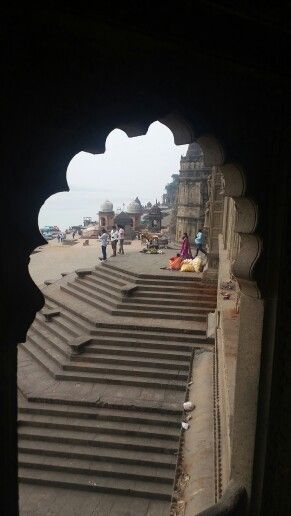
Omkareshwar is an island formed by Narmada. Crossing the river and going across the bridge over the river was such an exhilarating experience. Think of us all coming from such a water - starved land and used to dried up river beds to look at a broad expanse of water flowing!! 
IMG_20190630_091357.jpgThe monsoon winds were a welcome add-on value. All over India, literature and art go into overdrive celebrating the magical monsoon, not without reason.  Entire land - from the smallest creepy insects to huge elephants, from the short shoots of grass to the tall and broad trees, birds and human beings would be awaiting the moment when the dark clouds move in with the slight cool and wet wind and let go of the first drops of water. Yes, we all know the excitement and the relief when the first drops hit the parched earth. 
How would I not cheerful! The vast open lands that we crossed with the hint of forest at a distance, ploughed fields ready for the new season or lined with young saplings - Oh! I feel inadequate to express the beauty of all things around or my sense of gratitude , feeling blessed to be amidst all these! Then, wouldn't that be your feeling too, living in India?
IMG_20190630_105555.jpgIMG_20190630_105900.jpgIMG_20190630_105402.jpg

The darshan of Omkareshwar, one of the the 12 Jyotirlingas was brief and fleeting as would be the case in all the pilgrim centres of the country. We should have a certain frame of mind to look at the crowd, the long hours of standing and jostling by all kinds of people around.
We had to find which parts of the building were from around 11th or 12th century and which were modern. The older pillars, of course captivated us with the embellishments. 
IMG_20190630_112423.jpgIMG_20190630_111750.jpg IMG_20190630_112455.jpg

The ambience of the place, however, cast a spell on me with the name of Shiva resonating everywhere.
There is a cave below the temple along the river Narmada known to be where Shankaracharya met his Guru, Govindapada.  
  

I could imagine the chanting of the beautiful verses of 'Nirvanashtakam composed by Adi Shankara in front of guru Govindapada as a response to his question," Who are you?" (It is believed by many that the verses were composed by Shankara on that occasion.)
" मनोबुद्ध्यहंकार चित्तानि नाहं न च श्रोत्रजिह्वे न च घ्राणनेत्रे । न च व्योम भूमिर्न तेजो न वायुः चिदानन्दरूपः शिवोऽहम् शिवोऽहम् ।। "
It can be translated to mean as follows:
"Neither am I mind, nor intelligence,
Nor ego, nor thought,
Nor am I ears or the tongue or the nose or the eyes,
Nor am I earth or sky or air or the light,
But I am Shiva the all per
vading happiness"

   What an incisive and astute analysis of Advaita philosophy!


The above pictures show us going down into the cave where Govindapada met Shankara and the statues of guru and Shankara coming to meet him when Narmada gave way for him.

While walking out on the bridge, we gave in to temptation and bought spiced cucumber pieces and sweet and tart Jamun fruits. Mmm...wasn't that delicious! I enjoyed it more when many of us could share and enjoy that simple fun. 
Then there is Mamleshwar (Amreshwar) temple, right opposite Omkareshwar temple on the south bank of river Narmada. Mamleshwar is considered the original Jyotirlinga and both Omkareshwar and Mamleshwar are considered to be two halves of one Jyotirlinga. This 10th century temple is known for intricate carvings.

We had our lunch on a highway restaurant and moved to our second base - Maheshwar. As was the pattern, we got our brief introduction to the history of Maheshwar (The one aspect all of us knew very well is about the Maheshwari weave and the exquisite light weight sarees. Is it a surprise when majority of us are women?).

By the time we reached the city and our resort - a beautiful place on the banks of Narmada called Narmada Retreat - it was early evening. 


Yes! it is count down to Operation Maheshwar!   The exciting part of the evening began! We squeezed into 2,3 autos and straight went to the textiles shops to
indulge in a shopping spree!
Maheshwar had remained a major centre for hand loom weaving since 5th century and later under Holkars, enjoyed a royal patronage. Legend says that Rani Ahilya Bai appointed special team of craftsmen from Surat and Malwa region to weave a nine yards saree to gift to a royal guest. since then, the saree became a great success among the royal and aristocratic women. Now the weave has become popular not only within the nation but in the international market as well for its subtle hint of elegance combined with glossy finish and light weight. I know, out there, there are sighs of pleasure and expectation!  Hey! some of you may be in possession of a saree or two. 

Enjoy the colours here and be sure to get them and feel the softness of the weave soon! 
When you visit the fort, you will see the intricate designs on the walls as panels and do they look familiar? You are right! The motifs and designs on the textiles are a reflection of the beauty on stones.


  The steps in the above picture can be seen on the unique 'pallus' as five stripes (three coloured and white, alternating running along its width.
Gearing up for a shopping expedition? The experience is enhanced when we see the intricate design on the walls of the Fort, palace walls and temples. The next day, we roamed around the fort, listened to the story of the determined, brave and compassionate ruler - Devi Ahilya Bai and experienced her humble yet an all pervading presence in her palace. 
                                                                                   
Moving through the lands blossoming under the monsoon rain has a magic of its own! You too, get ready to soak in the experience!

Looking at my young days through the eyes of my seven year old.granddaughter

Going back to the place where I have learnt my first steps, where I picked up my first friend (who is still my best friend after about 6 decades!), where I experienced the joys, hopes, dreams, disappointments of being a young girl - always brings a nervous excitement in the pit of my stomach. Sure, you must be feeling such emotions when you visit your town/city, right?

Normally I prefer to walk the streets of the main city alone, while scenes of the past would be flashing on the mental screen - the busy school days, going to different book shops for buying the text books, just running out of the house to hop on to city bus;no 1 (bus stop was just bang outside our house, you know?) to go to college, the evening meeting with my best friend to discuss all world issues(!!), the summer holidays and rushing to watch the procession of the temple festival, the jasmine blossoms all around - in the vendors' baskets, adorning the hair of young girls and women of all ages, on the decoration of the God and goddess, Cows with their calves running along narrow lanes, milkmen milking the cows in a street corner,
 graceful women with skin glowing like polished ebony with chunk of gold on the big holes on their ear lobes (the jewellery is known as 'Pampadam in Tamizh.) swinging in tune with their swaying hips and oh! the unique sing-song sound and accent of the Madurai Tamizh - would carry me effortlessly through the winding lanes.

Now, in response to a long time urge, I travelled to my native place, in the exclusive company of my granddaughter(Kailu) who is going to be eight in a few months. The road trip  from Tiruvannamalai crosses at  least 4 districts, moves across Kollidam, Mani muthar and Vaigai rivers (only in name!) Stories from the past about the rivers in spate, the coconut groves along the banks flowed forth;all around  on the highway, the distant mountains and the chipped off rocky hillocks were telling the sad story of human greed and indifference to all other beings in nature.
I pointed out many things along the way to Kailu which she would have seen from an earlier trip. The cab driver caught on the mood of story time and listened to many of them and contributed his share even. 

All the new highways usually go round cities and towns avoiding the busy city centre. So ring roads and bypasses, it is! We certainly miss out on the characteristic sounds, smells and the people of these towns and cities but gain in comfortable travel. However, as we bypass a city, on the far left or right, we see the life from the city spilling out in so many ways. There are tall buildings, mountains or temples, that mark the towns, visible on the highway. "Here we are!, I excitedly pointed out to Rockfort and Srirangam as the typical identities of Trichy to Kailu. 

Hey, it is story time once again! The rockfort structure with cave temples at some height has a Ganesha temple perched on top. We can see the steps leading to the temple and the temple on top from afar driving down the highway. There is a Shiva temple at the base of this structure which has lot of interesting stories associated with it but one that I love is the one that describes the God as   Mathrubhootheswarar/'Thayumanavar' meaning 'Being mother as well'. 
Then like a slide show, the old route between Trichy and Madurai flashed in my mind - the huge banyan and tamarind trees on both sides of the road, the town or village square with people moving about their chores, the early morning breeze, an occasional  small tea shop with thatched roof on the side of the road and the excitement of the beginning of a term break and spending the days with my parents. 
Mid route stops (towns)like Kottampatti and Viralimalai now are far to the right of highway. it was like an exercise of comparison -  'This place, that day'. 

Remember, the driver was an active participant in the story telling exercise! So, he too shared his experience of driving on the highway or the temples he had visited as part of his driving job. Kailu with her incessant curiosity was lapping it all up with one expert grown up comment, " I was so sleepy that my eyes could not remain open; but the conversation was so interesting that it kept me wide awake."

Every stone on the way, each distinct plant, tree, small village that lie on the way has a great social, historical cultural story cached deep within, waiting for the right person to tap open the doors to that wonderful world - be it the glorious and prosperous days of Pandiya rule or the turbulent time of power rivalries, marching of the Turkish army and attack on temples or the heroism shown by ordinary people in saving the cultural, religious and artistic legacy from the onslaught or the time of Nayak rule when there was a beautiful blend of Shaiva and Vaishnava traditions of worship. 
By the time we shared some stories, we had come to the  bridge over Vaigai river and there! the noises, dust and the smells of whole sale fruit market swamped our senses. I could even show her the house where I had spent my first 22 years of life  (Sad, the house had been demolished and boarded up)
Kailu is open to experience new places with her own perception and over the two days stay, she has concluded that she likes the place! I tried to draw her attention to the way Tamizh is spoken there - she couldn't pick out the nuances but could sense the difference. 
She was a trooper to walk some distance and stand for an hour and more for Darshan of Goddess Meenakshi. We stayed in a simple Yatri Nivas (a Marvadi boarding house run as a charity). There will be at least 50 to 60 travellers from northern parts of the country daily, on a pilgrimage in groups. So it is a simple boarding house with a courtyard in the centre. No, nothing exotic or 'branded as typically Rajasthani or from a Tamil village, you see. A simple one but serves the purpose of that open space.
Once you step inside the building, all the hustle bustle of the city outside magically disappears. 
I wanted to show her the Thirumalai Nayak Mahal (palace), (was constructed as a residence for the king in 1636 CE) but, she got tired and it was getting late; so had to leave it for some future trip.  I know, the palace would look familiar to many of you if you are an avid movie watcher. Keep guessing, friends, it is very easy!


She lapped up the sights and sounds around the temple and My God! her excitement was so endearing when she ran around the shops selling craft items, accessories for stitching and bangles and bindi shops in Pudhumandapam! Items of similar type heaped in one place is such a delight for a shopping venture. However, I can't help thinking about the beautiful carvings and fine architecture that are hidden and taken a backseat to commercial interests. Then, there is the other side, isn't there? Small entrepreneurs, crafts persons, petty shop owners and many others are to be given an alternate and suitable space to move their ware from this Mandapam and it is a tough job, no doubt. 
Ah... I am meandering, again! This is about the past meeting the future and letting fresh air and light into that old room with layers of depth and character, right? 
She was contemplating, experiencing every moment with a 'here and now' approach. In my enthusiasm, if I start on my story telling spree (Should I say, non stop lecture??), she very clearly would stop me. That girl, she knows her mind and she sets the pace. Fair enough, won't you say? She needs time to work through each of the stories, sights and my feelings associated to them, so she indicated, it is one after the other! 
But I had kind of transmitted to her, the happiness, being surrounded by love and affection and the quest for finding the story behind every thing - at least it looked to me like that.  I showed her my school, the road I used to walk to go to school and the shops where we would crowd in the beginning of academic year to get our text books. Such an uncanny insight she has of the human emotions that she had caught the underlying motif woven into the story of that young girl, 50 years ago  - one of a care free life with lot of friends and a warm household where'things were happening' all the time. 

How do I know that? She started sharing about her friends, her happy moments, adventures and trips with occasional appreciative comments about the city, people and friends there. She wondered, whether I keep in touch with any of my college friends. I told her that I was able to meet only one friend who has a granddaughter like her. She nodded her head with a thoughtful expression. I know all these small details are to get a complete picture of the time/life that she has put in corner of her fertile imaginative mind. 

Those grandparents out there must feel the way I feel, I think. I felt like a young girl revisiting those days with this young one who is such an old soul. Some moments were beyond words but etched deep within my heart. I know, Kailu too had her special moments. With another promise to myself that there will be another exclusive trip for the two of us, we started our journey back.

The irony of my greatest passion going hand in hand with that big aversion of mine!

It is the strange association of music with the modern technology in my life for about the last eight years. In silent and subtle ways, technology has crept into the most joyful moments of my life - listening to music. In the rustle of petals, the whoosh of the wind, the rush of the waves breaking on the shore, chirping of the birds, drip drip of water from the taps, the sing song call of vegetable and fruit vendors and even the sounds of cooking I enjoy music. (Aren't there some daily sounds music to your ears? I know you have a list. Pause and enjoy them, friends.)

The story, however is not about waxing poetic!! As a very natural development in this part of the country (Tamil Nadu), I was initiated into Carnatic music from a very early age. Sing? Yes, I can and love giving solitary performances, unhindered by any one within the house, of course. More than that, I love listening to concerts, attending live performances when I can. So there is that constant thirst to listen more and learn more about the techniques and nuances of the Ragas, swaras, Alap and compositions. It is very common in many households to see all the family members listening together. Yes, it is a great bonding caused by music.

I had such great moments of sharing with my parents, particularly my father and my grand uncle. With gentle breeze of early summer nights, sitting in the veranda with a transistor playing the music (live and recorded broadcasts from AIR), life seemed one total bliss. Even as the artist hums a light outline of the raga, Appa would recognise the raga and would also guess what composition would follow. And when the artist would start singing the composition(most of the times it would be what my father had guessed), there would be a child like smile lighting his face that had been so clearly etched in my memory.
"So what is this story about the 'dreaded technology' ?"- I can sense your impatience! Coming to that in a moment.
Those were the days when I was trying to befriend technology; making an effort to be self sufficient with certain basic skills needed for daily dealings and my 'love - hate relationship with technology began. I ventured out into social media with lot of caution clicking something, exploring a new site and slowly learnt about groups. I  clicked to join a media group meant exclusively for Carnatic music and felt thrilled when I was accepted. I was proud and humbled as well to be part of learned discussion about carnatic music, its nuances and techniques.

There is a weekly concert streamed through their radio and on special occasions, thematic concerts will be webcast. I have been enjoying good music along with enhancing my knowledge about the compositions, their meanings, the distinct feature of each raga, other technical and theoretical aspects of Carnatic music. 
Shruti and laya, I know. But then, I get to learn about briga, gamaka, jeeva swara and nyasa swara, kaarvai and many others during the course of their conversation while listening to the concerts. That is the 'icing on the cake', don't you think?
(Kaarvai is holding onto a particular swara for a longer interval of time;
Jeevaswaras are the quintessential swaras which lend life to a particular raga;
Gamaka is the shake, grace, embellishment given to particular swaras(instead of plain notes) to add to the beauty;
Briga is a speedy rendition of a particular phrase of a raga;
Alaap or alaapana is the abstract essaying of a raga - elaborating the raga;)

I am still faced with many challenges in my relation with technology; it is moody with sudden non responsiveness and closing off during an important task. But to give credit where it is due, I have moved on from being an unwilling partner to being a close acquaintance with technology. 
When I got an opportunity to listen to Thanjavur S. Kalyanaraman's concert in Radio web Carnatic with all the expert comments from group members, I remembered the association between technology and music and no other moment can be more apt!
He observed the sounds with an analytical approach and loved to experiment with swaras, ragas or the way the musical sounds originate. AS his sister mentioned, he tried "to identify the originating position of the seven swaras in the human body."
What more? He adopted a scientific method to teach his students singing pitch perfect ragas and music.  He was way ahead of his times. With his melodious voice, in depth knowledge of the classical music, passion for experimenting and perfection, his music was just magic! 

This evening's concert was equally a gem and the ragas  - surutti, Kanada, Thodi and Shanmukapriya - glided with a gentle sway here and an energetic sweep there; teasing me flirtatiously sometime or engulfing me in their warm folds!
Don't worry, folks. I am not going into too much technical or theoretical aspect of the music. Anyhow, that is for a critical analysis and I simply want to enjoy good music and share it with you people. 

Good music in any form appeals to me and I think it does to all of you guys. I do visualise the music and it will be like scenes of a movie running one after another -  tall distant azure mountains, a vast blue sky with puffy white clouds, gurgling water of a clear cold stream, the distant coconut palms gently swaying in early summer breeze... there are more. Care to join me, next time?


A unique travel experience - 3

To dream big!


It was my long time dream to stand in front of that impressive monument.As we approached the place, with abated breath, I waited for that exact moment when my eyes would behold that grandeur. Oh! there it was! As our bus turned to move along the outer walls, looking across the centuries past, it stood - a silent witness to the transiency of human life. Something jumped and shifted deep within me with the first glimpse. 

"How did you feel being the only son and most loved, guiding the Chola army to victory after victory, fulfilling your revered father's every dream, Prince Rajendra?" - I silently threw the question at the walls of Gangai Kondacholapuram temple, the massive Nandhi and the tall Vimana. Do you think, by any chance, I would get an answer through these creations that were the result of his dreams? 

Every stone, pillar and sculpture of the temple has Rajendra's name etched on them. You try standing in front of the structure and try to communicate with it! Then you will know my feeling. When he planned to build a new capital, naturally to his Lord and God (Shiva), he wanted to build a temple. He marched up to Bengal (the then Pala kingdom), conquered them and brought water from Ganga to consecrate the temple here.  The descendants of the master builder of Thanjavur temple were the builders here. The massive size, the Nandhi and some basic structures are similar in both places but each of them has a character of their own. 

Gnana Saraswati
When we were moving around in the Prakara (प्राकारम् - the pathway around the sanctum), the walls  stun you with elaborate carved niches with beautifully sculptures deities placed within. The Gnana Saraswati and the one called 'Sandeswara Prasadam' filled my heart with an indescribable emotion. 

Sandeswara Prasadam

 Are you wondering about who this Sandeswara is? Hey! I am certainly not going to start off a story telling session! Just know that he was one ardent devotee of Lord Shiva and Shiva blessed him and gave him an important role of keeping track of the people coming into the temple to worship. Can you see Sandeswara bowing in front of Shiva and accepting a garland?  

The professor, expert in different disciplines, put forth an interesting perspective about the long wait in the wings  - of the most worthy son to be recognised as the crown prince to duly succeed the illustrious father. If you know a little bit of Chola history, you may recall that for a few years towards the end of Rajaraja's reign, Rajendra was the co-regent. I leave it to you to link the dots. Sandeswara here, represents Rajendra who gets his recognition and authority from the Supreme Lord Himself (Obviously!)


You can understand my feelings, can't you? The place does not appear as a mere granite monument to me. Wasn't it trying to tell me about that young man with a great vision?Beginning with this temple, what we experienced in the other two temples as well made me wonder - who is scientifically and technically advanced. 

The pilasters (Architectural designs carved as projections in walls with placing of deities within it), the beautiful sculptures of different deities within the niche, the huge Vimana (sanctum tower), the molded horizontal projections (cornices) or their knowledge of proportions, aesthetics and precise calculations of where to put what kind of structure  and its weight... Ooh! let me take a breath!

Sh-shh.. want to share a secret with you all! (then it is no secret, do you say? So be it!) When I stood before those beautiful creations, I wanted to break out in a song -dance sequence like our Bollywood/Tollywood or whatever! You want to try and find out how you would feel? Good idea!

We would cover the other two 'Great  Living Chola Temples' in the coming two days - built by three  Chola kings - Great Rajaraja, Rajendra, his son and  Rajaraja II (12th century). Each stands a true representative of the period and the king responsible for its building.
I retired for the night but like a chocolate lover being promised a great treat after a good night's sleep.


Here is something 'for the road', friends. Here are the three temples.Look at the shape of the vimana, the structure and size. Ride on your imagination till we meet again.


A unique travel experience -2

Walking on the path of Vandiyathevan
A historical trip/ heritage tour? What is it that I have signed myself in for? Wasn't that going to be a nostalgic trip for the die-hard fan of the novel? Yes, the churning in my mind had begun with the tour day fast approaching. Patience, my friends. The tour organisers had put together a tour to ensure a rich, well rounded experience, no doubt! But I was curious as to when and how would they introduce us to a brief study of Chola history and the war strategies of Rajendra Chola as their itinerary promised.

I was excited as April 26th was just round the corner. How many ever trips I make - long/short; brief/overnight; by road/train - I love the preparations of packing and completing tasks in hand on time. On these types of tours every thing is new - new people to befriend, new places to visit, new boarding houses and new food!That adds to the excitement, don't you think?  Finally, the moment came. When I boarded the bus, the first of the introductions were already over as we were waiting in the same pick up point.

Darkness was falling outside and inside the bus, we had our introduction session and snacks to munch along. If you think, the six hours of travel went like this, you are mistaken. The first session of lecture cum slide shows with flow charts and maps began in the bus. It covered the dynastic history of Cholas, the cultural aspects of life then and the list of sources of history. I wonder how Mr. Ramesh, who was in charge of such lectures did this without slipping up anywhere. ("Been there and done it all"as a history teacher.) An interesting warm up?  
Amidst a soothing green of tall coconut trees, flowering plants and mango trees, there is an old style Zamindar bungalow with an extension serving as a resort and yes, it was our first stop. Morning, we woke up to chirping birds and a quiet dawn. 
With a tempting and delicious spread of home made 
array of dishes, I had to be monk renouncing the pleasures of taste, not to overeat. Only a wee bit, I shushed the warning voice! 

We began the exploration of the day - to walk on the trail of the spy along the Veeranarayanapuram lake. I could remember the unfolding of the scenes of festivity along the lake and our hero's thoughts very vividly.

"What joyous delight even as I approach the Chola Kingdom! What wonders will the fertile, bountiful land beyond Kollidam hold? How would the men and women of that country behave? How many rivers? How many reservoirs? How many clear streams? How wondrous would be the river Ponni (Cauvery) praised in song and epic?" 
This is how our hero Vandiya thevan - heart swelling with pride - moved along the lake. When I stood on the banks of the lake, with fair amount of water, was there any reason for me to feel other than pride?  The sheer size, about 72 canals/floodgates still in working condition and wise water conservation and management techniques of about 1000 years ago definitely make us proud but what is our role here?  


It was still early days of the new Chola kingdom when they have to face imminent threat of invading armies from Rashtrakutas (north) or a constant attack from the long time enemies - Pandyas. Prince Rajaditya with his army was anticipating an invasion from the Rashtrakutas but what should a responsible and future king do while waiting? He did not keep his soldiers idle but involved them in building a lake which would receive waters from the northern tributaries of Cauvery. A lesson or two for our political and corporate leaders, eh?
How did he name it? Certainly not after him but to honour his father, Parantaka, he named it Veera narayanapuram lake. 

With a promise that we would walk the road once again in the evening we went in search of Kadambur palace - where secret meetings took place and plans to murder the ailing Chola king (Sundara Chola), the crown prince (Aditya Karikala) and his younger brother, Arulmozhi varman (who later becomes the great Chola ruler, Rajaraja I). There are ruins of what could have been a palace but the temple nearby has an important inscription about the trial of the murder of the crown prince. The inscription clearly mentions the names of the three brothers whose brainchild was the assassination plot. There are different versions about why these three were not punished but one thing is certain - the lands of even the distant relatives of these people were confiscated by the government. 
The local expert, an octogenarian scholar and teacher regaled us with many stories about the places on the way the past and present scenario and presented a vivid picture of the trial for the murder of Aditya Karikala, conducted by Rajaraja at the very same place in that temple where we sat around him. I was trying to understand and absorb the depth and intensity of the events. My mind kept coming back to the same point - Rajaraja, the individual and wondered what kind of emotions he had to hide and what he had to exaggerate?
But then refreshing drinks - typical local versions like 'Nungu'(Palmyra fruit), Nannari sherbet (Sarsaparilla) and others were waiting for us back in the resort; the local farmers had an entertainment planned for us - a skit depicting the chieftains coming together at Kadambur playing power games too was part of the afternoon plan. 
Then of course, evening would bring us a visual treat - which words cannot do justice to! 

A unique travel experience

Getting ready to soak in history!

When I was young, back in the early sixties of the last  century, this historic novel came as a serial in a magazine which captivated the young and the old alike. It became a staple diet for my friend and myself who loved the romantic and glorious past.  
It was a historic novel written by Kalki Krishnamurthy, a great writer, known for his vivid style with the right amount of humour. The novel when later published as a book, ran into five volumes. It describes the story of Arulmozhi varman who went on to be known as the great Chola king, Rajaraja I later. This novel is considered his magnum opus wherein he had taken two or three historic events, added a few fictitious characters (memorable ones!) and spun a beautiful story of intrigues, conspiracies and romance. 
The pace is gripping and the plot unfolds with enough suspense that it reels in readers even today. Wonder if we can attribute the magic of the novel entirely to the brilliant writing style or is it something more?
Today with the ever growing influence of social media, I see so many Facebook groups coming together as avid fans of the novel and showing interest in the history. To quote 'Outlook' magazine," Some stories grow so big they become inevitable. Tamil Nadu's phenomenally popular epic novel,'Ponniyin Selvan' is one such tale." 
The title means 'The son of Kaveri' or Ponni's beloved'.
Ever since the first time I was hooked to follow the spy, Vandiathevan (one of the protagonists) on his trail ( the novel opens up when he moves along slowly on horseback along Veeranam - Veeranarayanapuram-Lake (Eri in Tamil)), how many more times I would have travelled the path along with him feeling a sense of excitement!
So begins the novel!
"....about two leagues far to the west of Thillai Chittrambalam, (Chidambaram Town) there spreads an ocean-like reservoir. It is known as Veera Narayana Lake. It is about a league and a half long north to south and about half a league wide east to west. Time has twisted its name: for these days the reservoir is known as Veeraanatthu Lake ... In the windy months of Aadi-Aavani (August), when new floods fill the reservoir to almost overflow, anyone who looks at the Veera Narayana lake will surely recall with pride and astonishment the splendid deeds of our ancestors in Tamil Nadu. Did those ancients do things merely for the welfare of themselves and the people of their own times? ... On the 18th day of the month of Aadi, in the early hours of the evening, a young warrior, mounted on a horse, was riding down the banks of this ocean-like Veera Narayana Lake. Vallavarayan Vandiya Devan was his name. Having travelled a long distance and being worn and weary, his horse was walking along rather slowly. The sprawling reservoir had so enchanted his heart!"
 (On land, the league is most commonly defined as 3 miles - 4.83 km)
Do I mean to say that the lake still exists, serving a valuable purpose? Is it still in workable condition with water flowing in from tributary of Kaveri, no kidding? 
After about five decades, an opportunity presents itself in front of me, the wanderer, to actually walk on the path of my hero! Will I let it slip off my hands! 
Young People with passion to study our glorious past and know about our heritage have come together with a few subject experts and scholars to provide a rich experience. So the heritage trip is named 'In the trails of the spy'. 
It covers a few important places - the places of action in the real past or in the novel. The trail starts from the lake as in the novel but then moves on to places nearby which have witnessed a battle or a plot unfolding or the great temples which were brought to life from the lofty dreams of the father and son duo - Rajaraja I and Rajendra Chola.
How does it feel to breath the same air that those warriors and great administrators breathed; to walk on the same land where the warring armies marched? 
Veeranarayapuram Lake (the saviour of Chennai city -providing the life-giving water), the old capital of Cholas (Pazhaiyarai - now a small village), Udaiyalur (where the great king, Rajaraja's  Samadhi is ), the awe inspiring magnitude of Thanjavur and Gangaikonda Cholapuram temples, the sheer beauty of the Darasuram temple (sculptures coming alive out of granite) the battle site of Thirupurampiyam (which marked the rise of the later Chola kings)  - delight to the history buff!
Am I one? What do you think? Do you want to come along with me?

Understanding our legacy


Wander lust, the longing to find the hidden stories in the life, language and customs of people and the awe inspiring forts and temples which had witnessed the rise and fall of dynasties   - What else do I need to pack a bag, don a hat and plunge into the mysterious world of travel?
Quite a lot of us born in the fifties of the previous century have been nurtured on a diet of interesting historic novels, here in Tamil Nadu. Many of them would be about the great Imperial Cholas and the tour is structured around one particular novel (Son of Kaveri - ‘Ponniyin Selvan’ in Tamil). The romantic in me would have travelled along with them on horseback, been part of important court discussions, even fought alongside with the great warriors and more than that, I would be the brave princess or the wise one whose words influenced the history of the kingdom!
So, is it a surprise that I readily joined the heritage tour which promised to provide a glimpse into the glorious period of king Raja raja Chola and his son, Rajendra?
Thoughtful tour schedule, well organised stays and the dedication and commitment of the tour organisers simply enriched the experience.
What struck me from the beginning is the organisers’ drive to not only initiate us into recognising and appreciating our heritage but to motivate us to carry it forward to the next generation.
The novel begins along the banks of the vast Veeranarayapuram Lake where the protagonist, the smart and quick witted spy Vandiyathevan would be riding on his horse to reach the Chola capital, Thanjavur. But for this lake, there would have been a great water crisis for the people of Chennai as this lake is the supplier of major share of water needs of Chennai. We took a few minutes to think of the foresight of a Chola prince during 10th century in building this 11.2 Km long and 4 Km wide lake.
In the 19th century, British engineer, Arthur Cotton was highly impressed by the strong structure of the lake. Here we are, utterly indifferent to the wisdom, plan and skill that have made this water reservoir more than 1000 years ago!
The story unfolds as he encounters some challenges, meet people from different walks of life. The story is woven around a few historical facts like the murder of the crown prince and how later, Raja Raja comes to throne.

We moved along the spy’s trail, visiting certain battle fields, temples built around hero stones and of course the temples of Darasuram, Gangaikonda Cholapuram and the Thanjavur temple - architectural and engineering marvels and World Heritage sites.  
The entire tour was approached from different angles - intellectual, emotional and sensory.
The temples are visual delight and when experts in ancient architecture and sculpture were there to direct our attention to details, it simply enhanced the experience. And each carving, each niche, turn, pillars and corners of those beauties in granite tell a different story and what kinds of drama they hold within!
 Three different temples, built by three different kings - father, son and grandson - each unique in its grandeur, character, structure such that each truly reflected the character of the king who built them. At least to me, that is how it appeared.
 
When we stood in front of Thanjavur ‘big temple’ in the morning just before sunrise, the sky was overcast. People have already started inching in. I do not think anyone can enter without being stunned at the entrance (Gopura). The sheer magnitude of the outer walls, the thickness and height, the once - present moat, the inner wall, and the two dwarapalaka (gate keepers) take your breath away. 
 We had a great scholar, expert in conservation architecture, archaeology, iconography, sculpture, history, literature, and marine archaeology (and all other disciplines under the Sun) to explain things to us. The moment he began highlighting the great features of the gate, height, width, length and other structural aspects passionately with pride, something deep within me moved. I felt as though, the spirit of the great king blessed that moment and all of us there.  

The battleground of the decisive battle which marked the beginning of Chola Empire is now green paddy fields but they are aware that those ancestors who fought the war and had died there were buried under their fields. There is a reverence and pride when they talk about it and we had a lot of fun when they presented a skit based on one incident from the novel.

  
The whole account would remain incomplete, if I do not mention the human factor. The experts’ explanations and other slide shows of the dynastic history were all interactive and the simplicity and ease with which the expert scholars joked around and tirelessly explained many things provided for an interesting learning. The villagers on the way, wherever we stopped for a site visit, showered us with their unreserved affection and open hospitality. We were loaded with tender coconuts, millet porridge, buttermilk and snacks. I was pleasantly surprised by the sense of history and the awareness about 1000 and more years of cultural and political legacy that sits well on their shoulders. The honest and open look and that megawatts smile that light the entire place - Oh! Where have we lost that warmth and human touch! 
All of us - belonging to this land regardless of the narrow restrictive regional and linguistic identity can be proud of this legacy for these two great kings dreamt big and scaled great heights.  


Do you have any questions?

  प्रश्नः,  प्रश्न , 'கேள்வி ,  ചോദ്യം (chodyam), 'Prashna' - ప్రశ్న, প্রশ্ন, प्रश्नः,  प्रश्न , ಪ್ರಶ್ನೆ( Praśne ), પ્રશ્ન, سوا...